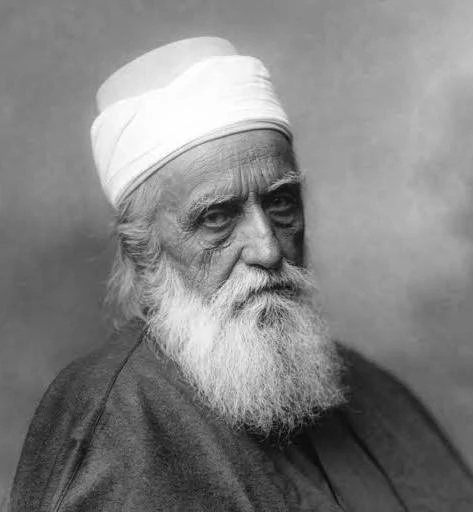
In 2026, the Ascension of ʻAbdu’l–Bahá is observed on Saturday, November 28, 2026 (beginning at sundown on Friday, November 26
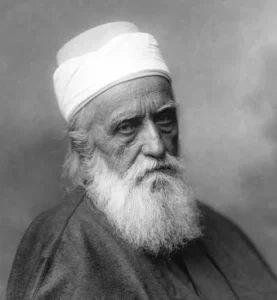
• Significance: Commemorates the passing of ʻAbdu’l-Bahá on November 28, 1921, at age 77 in Haifa. As the eldest son of Baháʼu’lláh (Prophet-Founder of the Baháʼí Faith), he served as the appointed successor and authorized interpreter of Baháʼí teachings.
Observance: Baháʼís typically gather for devotional readings and prayers including
closing Prayer & Recitation of the Tablet of Visitation for ʻAbduʼl-Bahá, often culminating around 1:00 AM.—the time of his passing. Unlike some other Baháʼí holy days, work is not suspended.
ʻAbdu’l-Bahá was born in Tehran to an aristocratic
family in Persia (now Iran) on 23 May 1844 (5th of Jamadiyu’l-Avval, 1260 AH), the eldest son of Baháʼu’lláh and Navváb. He was born on the same night on which the Báb declared His Mission.
ʻAbdu’l-Bahá’s given name was ʻAbbás at birth. He was named after his grandfather Mírzá ʻAbbás Núrí, a prominent and powerful nobleman. Depending on context, he would have gone by either Mírzá ʻAbbás (Persian) or ʻAbbás Effendi (Turkish), both of which are equivalent to the English Sir ʻAbbás. During most of his time as head of the Baháʼí Faith, he used and preferred the title of ʻAbdu’l-Bahá (“servant of Bahá”, a reference to his father). He is commonly referred to in Baháʼí texts as “The Master”.
ʻAbdu’l-Bahá’s early years were shaped by his father’s prominent role within the Bábí community. As a child, he fondly recalled interactions with the Bábí, Táhirih, describing how she would take him on her knee, caress him, and engage in heartfelt conversations, leaving a lasting impression on him.
His childhood was characterized by happiness and carefree moments. The family’s residences in Tehran and the countryside were not only comfortable but also beautifully adorned.
Alongside his younger siblings – a sister, Bahíyyih, and a brother, Mihdí – he experienced a life of privilege, joy, and comfort. ʻAbdu’l-Bahá loved playing in the gardens with his younger sister, fostering a strong bond between them. During his formative years, ʻAbdu’l-Bahá observed his parents’ commitment to various charitable endeavors, including the conversion of part of their home into a hospital ward for women and children.
At the age of eight, his father was imprisoned during a government crackdown on the Bábí Faith and the family’s possessions were looted, leaving them in virtual poverty. His father was exiled from their native Iran, and the family established their residence in Baghdad in Iraq, where they stayed for ten years. They were later called by the Ottoman state to Istanbul before entering another period of confinement in Edirne and finally the prison-city of ʻAkká (Acre).
ʻAbdu’l-Bahá remained a prisoner there until the Young Turk Revolution freed him in 1908 at the age of 64. He then made several journeys to the West to spread the Baháʼí message beyond its middle-eastern roots, but the onset of World War I left him largely confined to Haifa from 1914 to 1918.
Due to a life largely marked by exile and imprisonment, ʻAbdu’l-Bahá had limited opportunities for formal schooling. In his youth, it was customary for children of nobility, including ʻAbdu’l-Bahá, not to attend conventional schools. Instead, noblemen typically received a brief education at home, focusing on subjects such as scripture, rhetoric, calligraphy, and basic mathematics, with an emphasis on preparing for life within royal courts.
When ʻAbdu’l-Bahá was a young man, speculation was rife amongst the Baháʼís as to whom he would marry. Several young girls were seen as marriage prospects but ʻAbdu’l-Bahá seemed disinclined to marriage.
On 8 March 1873, at the urging of his father, the twenty-eight-year-old ʻAbdu’l-Bahá married Fátimih Nahrí of Isfahán(1847–1938) a twenty-five-year-old from an upper-class family of the city.
Her father was Mírzá Muḥammad ʻAlí Nahrí of Isfahan, an eminent Baháʼí with prominent connections.
Fátimih was brought from Persia to ʻAkká after both Baháʼu’lláh and his wife Navváb expressed an interest that she marries ʻAbdu’l-Bahá.
After a wearisome journey from Isfahán to Akka she finally arrived accompanied by her brother in 1872.
The young couple were betrothed for about five months before the marriage itself commenced. In the meantime, Fátimih lived in the home of ʻAbdu’l-Bahá’s uncle Mírzá Músá. According to her later memoirs, Fátimih fell in love with ʻAbdu’l-Bahá on seeing him. ʻAbdu’l-Bahá himself had shown little inkling to marriage until meeting Fátimih; who was entitled Munírih by Baháʼu’lláh. Munírih is a title meaning “Luminous”.
The marriage resulted in nine children. The first born was a son Mihdí Effendi who died aged about 3. He was followed by Ḍíyáʼíyyih K͟hánum, Fuʼádíyyih K͟hánum (who dies very young), Rúhangíz Khánum (d. 1893), Túbá Khánum, Husayn Effendi (d. 1887 aged 5), Túbá K͟hánum, Rúhá K͟hánum (mother of Munib Shahid), and Munnavar K͟hánum. The death of his children caused ʻAbdu’l-Bahá immense grief – in particular the death of his son Husayn Effendi came at a difficult time following the death of his mother and uncle.
The surviving children (all daughters) were; Ḍíyáʼíyyih K͟hánum (mother of Shoghi Effendi) (d. 1951) Túbá K͟hánum (1880–1959) Rúḥá K͟hánum and Munavvar K͟hánum (d. 1971).
Baháʼu’lláh wished that the Baháʼís follow the example of ʻAbdu’l-Bahá and gradually move away from polygamy. The marriage of ʻAbdu’l-Bahá to one woman and his choice to remain monogamous, from advice of his father and his own wish legitimised the practice of monogamy to a people who hitherto had regarded polygamy as a righteous way of life.
On 28th November 2026, Baháʼís all over the world observe the 105th anniversary of the passing of ʻAbdu’l-Bahá , who ascended to the next world more than a hundred years ago – and left the world a legacy of universal love.
In those observances, which will take place sequentially at 1:00 a.m. in each time zone as the planet spins on its axis, the world’s Baha’is will unitedly recognize ʻAbdu’l-Bahá’s life of great service and devotion to the Baháʼí ideals of peace, love, and unity. For the span of an entire 24-hour day, Baháʼís everywhere will pray together, read from ʻAbdu’l-Bahá’s writings, and commemorate his unprecedented promulgation of peace.
Following the war, the openly hostile Ottoman authorities were replaced by the British Mandate over Palestine, during which time ʻAbdu’l-Bahá was appointed a Knight Commander of the Order of the British Empire for his help in averting famine following the war.
The British government was impressed with ‘Abdu’l-Bahá’s heroic actions during the war. On April 27, 1920, leaders gathered in Haifa to honor him. They sent a magnificent car for ‘Abdu’l-Bahá, but he chose to ride in a simple wagon to the ceremony. There, at age 75, so near the city whose citizens had once rejected him, he was named Sir ‘Abdu’l-Bahá ‘Abbás, Knight of the British Empire.
At the age of 77, on November 28, 1921, the Head of the Baháʼí community, born Abbas Effendi and fondly called “The Master;” the son of Baha’u’llah, the Prophet-Funder of the Baha’i Faith, and the Center of his Covenant; dearly loved and revered around the world for his service to humanity and his advocacy for peace and unity; knighted by the British Empire for his work feeding the poor and averting famine in Palestine during World War I; drew his final breath and passed into the next world.
Then Colonial Secretary Winston Churchill telegraphed the High Commissioner for Palestine, “convey to the Baháʼí Community, on behalf of His Majesty’s Government, their sympathy and condolence.”
Similar messages came from Viscount Allenby, the Council of Ministers of Iraq, and others.
ʻAbdu’l-Bahá, a prisoner and an exile for most of his life, never let his imprisonment compromise his joy, his love, or his service to humanity.
His passing unleashed a torrent of profound distress and grief, not just for the Baha’is around the world but for everyone who knew him or knew of him. People from every religion and no religion deeply mourned. ʻAbdu’l-Bahá’s funeral service brought together even the divided Holy Land, drawing admirers from every race, religion, age, background, class, and walk of life. A great sense of loss and grief gripped those who attended, and its intensity united them. In the Holy Land, ʻAbdu’l-Bahá’s unprecedented impact, and the outpouring of emotion that accompanied it, resulted in an unparalleled funeral.
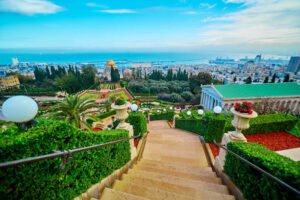
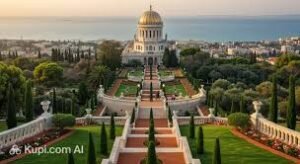
ʻAbdu’l-Bahá was memorialized and laid to rest on Tuesday, November 29th, 1921 on the slope of Mount Carmel in Haifa, Palestine. Thousands upon thousands of people walked up the steep mountainside, “A great throng,” the British High Commissioner of Palestine wrote, “had gathered together, sorrowing for His death, but rejoicing also for His life.”
The Governor of Jerusalem said “I have never known a more united expression of regret and respect than was called forth by the utter simplicity of the ceremony.”
Media observers estimated that more than ten thousand people attended: Arabs, Turks, Persians, Kurds, Armenians, Europeans, Americans, Jews, Catholics, Orthodox Christians, Anglicans, Druze, Muslims, and Baha’is, government officials and clergy and the wealthiest and the poorest, all there to show their abiding respect for the man one newspaper account called “The Personification of Humanitarianism.”
Mourning, moaning, and lamenting, the huge crowd collectively felt such a deep sense of loss that many attendees struggled with their emotions.
The sounds of sobbing and weeping filled the air. The mourners wept because they had lost someone so unique and so humble, so wise and selfless and dedicated to the service of others, that they feared they had lost something irreplaceable, something enormously precious, not just a man but a truly heroic and transcendent soul.
Their sorrow was understandable. Many in that gigantic crowd literally owed their lives to Abdu’l-Baha, either for the generous donations he had given the poor for decades, or for the grain he had stored to feed the starving people of Palestine during World War I, or for his long history of tending to the sick regardless of their class or creed, or for the kind spiritual counsel he gave to everyone.
If the old saying that you can judge a man by his funeral is true, then Abdu’l-Baha’s interment produced one of the most spontaneous, profound, and public outpourings of affection, warmth and tenderness the Holy Land had ever seen — and proved Abdu’l-Baha’s teaching that happiness born of love lasts forever. On his funeral, which was held the next day, Esslemont notes:
… a funeral the like of which Haifa, nay Palestine itself, had surely never seen… so deep was the feeling that brought so many thousands of mourners together, representative of so many religions, races and tongues.
Among the talks delivered at the funeral, Shoghi Effendi records Stewart Symes (Governor of the Palestine North District) giving the following tribute:
Most of us here have, I think, a clear picture of Sir ʻAbdu’l‑Bahá ʻAbbás, of His dignified figure walking thoughtfully in our streets, of His courteous and gracious manner, of His kindness, of His love for little children and flowers, of His generosity and care for the poor and suffering. So gentle was He, and so simple, that in His presence one almost forgot that He was also a great teacher, and that His writings and His conversations have been a solace and an inspiration to hundreds and thousands of people in the East and in the West.
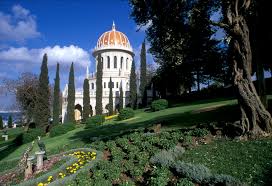
He was buried in the front room of the Shrine of the Báb on Mount Carmel. His interment there is meant to be temporary, until his own mausoleum can be built in the vicinity of Riḍván Garden, known as the Shrine of ʻAbdu’l-Bahá.
ʻAbdu’l-Bahá left a Will and Testament that was originally written between 1901 and 1908 and addressed to Shoghi Effendi, who at that time was only 4–11 years old. The will appoints Shoghi Effendi as the first in a line of Guardians of the religion, a hereditary executive role that may provide authoritative interpretations of scripture.
ʻAbdu’l-Bahá directed all Baháʼís to turn to him and obey him, and assured him of divine protection and guidance.
Shoghi Effendi later formalized his legacy as the last of three “Central Figures” of the Baháʼí Faith and the “Perfect exemplar” of the teachings.
Bahá’u’lláh directed His followers to turn to ‘Abdu’l-Bahá after His passing.
The significance of His passing was noted in media accounts around the world. His funeral in Haifa was attended by about ten thousand people, including Jews, Christians, Muslims, Druze, Egyptians, Greeks, Turks, Kurds, and a host of His American, European and other friends.
At the age of 77, on November 28, 1921, ‘Abdu’l-Bahá’s passing unleashed a torrent of profound distress and grief, not just for the Baháʼís around the world but for everyone who knew him or knew of him. People from every religion and no religion deeply mourned. Abdu’l-Bahá’s funeral service brought together even the divided Holy Land, drawing admirers from every race, religion, age, background, class, and walk of life. A great sense of loss and grief gripped those who attended, and its intensity united them. In the Holy Land, Abdu’l-Bahá’s unprecedented impact, and the outpouring of emotion that accompanied it, resulted in an unparalleled funeral.
Their sorrow was understandable. Many in that gigantic crowd literally owed their lives to ʻAbdu’l-Bahá, either for the generous donations he had given the poor for decades, or for the grain he had stored to feed the starving people of Palestine during World War I, or for his long history of tending to the sick regardless of their class or creed, or for the kind spiritual counsel he gave to everyone.
Baháʼís observe 11 Holy Days each year, starting at sunset the evening before the listed date. Work and school are suspended on nine of them, while work continues on the final two.Nine Holy Days (Work Suspended)
Naw-Rúz (Bahá’í New Year): Marks the spring equinox and the end of the Nineteen-Day Fast (March 20/21; March 21, 2026).
First Day of Riḍván: Commemorates Bahá’u’lláh’s declaration of His mission in 1863 and the start of the twelve-day Riḍván festival (April 20/21; April 21, 2026).
Ninth Day of Riḍván: Celebrated during the twelve-day festival (April 28/29; April 29, 2026).
Twelfth Day of Riḍván: Marks the end of the twelve-day festival (May 1/2; May 2, 2026).
Declaration of the Báb: Commemorates the Báb announcing His mission in 1844 (May 23/24; May 24, 2026).
Ascension of Bahá’u’lláh: Marks the passing of Bahá’u’lláh in 1892 (May 28/29; May 29, 2026).
Martyrdom of the Báb: Commemorates the execution of the Báb in 1850 (July 9/10; July 10, 2026).
Birth of the Báb: The first of the Twin Holy Birthdays, calculated by the lunar cycle after the eighth new moon following Naw-Rúz.
(November 10, 2026; October 30, 2027).
Birth of Bahá’u’lláh: The second of the Twin Holy Birthdays, observed the day after the Birth of the Báb (November 11, 2026; October 31, 2027).
Two Holy Days (Work Not Suspended)
Day of the Covenant: Honors the Covenant of Bahá’u’lláh and the appointment of ‘Abdu’l-Bahá as its Center (November 25/26; November 26, 2026).
Ascension of ‘Abdu’l-Bahá: Marks the passing of ‘Abdu’l-Bahá in 1921 (November 27/28; November 28, 2026).
The below passage was written by ʻAbdu’l-Bahá in a Tablet to the Bahá’ís in America just days before His passing on November 28, 1921.
“In the cage of this world I flutter even as a frightened bird, and yearn every day to take my flight unto Thy kingdom. Ya-Bahá’u’l-Abhá! Make me to drink of the cup of sacrifice and set me free.”
Compiled by:
Jaya Raju Thota,
Greater Visakhapatnam, Andhra Pradesh,
India.