GENEVA—23 February 2026—The “persistent and systematic discrimination” of Baha’is in
Egypt has been exposed in a trio of United Nations reports, each released this month, criticising
Egypt’s civil and religious authorities for persecuting the Baha’i religious minority over decades
and calling for their rights to be respected.
Welcoming the latest UN reports, Dr. Saba Haddad, Representative of the Baha’i International
Community to the UN in Geneva, said: “Three UN reports published at once, revealing and
condemning the grave injustices suffered by the Baha’is of Egypt, demonstrates that this
persecution is worsening and that the community is reaching a critical point in its suffering.”
The UN High Commissioner for Human Rights, Volker Türk, exposed in his report the
“persistent and systemic discrimination faced by members of the Bahaʼi minority in Egypt” and
called for its immediate end. Baha’is are “denied official recognition as persons before the law,”
the High Commissioner’s report added, despite Egypt’s constitutional guarantee of freedom of
religion or belief. The intervention follows a recent escalation in decades of systemic persecution
through discriminatory policies and practices—underscoring the gravity of the situation and the
urgent need for corrective action by Egyptian authorities.
Mr Türk’s report notes that, because they lack legal status and proper safeguards in Egypt,
Baha’is are barred from registering their marriages, cannot participate in the cultural life of their
community, and face other restrictions.
Baha’is have in the past have tried to marry through civil unions outside Egypt—so as to live as
married couples within the country. But they discovered that, within Egypt, the Ministry of
Interior had issued a bylaw denying Baha’is the right to certify these marriage.
And in a separate issue, after the Ministry of Justice advised Baha’is to appeal through the courts
to be allowed to change their status to “married” on their IDs, which for several years Baha’is
were then able to do, it emerged in 2022 that the Ministry of Interior began blocking these
appeals. Baha’is who had been able to do this in the past found that, when their IDs were due to
be renewed, their status reverted back to “single” on the new documents.
The human cost of the persecution Baha’is face in Egypt is profound. The child of a Baha’i man,
married to someone who is not a Baha’i, has been denied education at several schools because of
the father’s faith. A single mother of two faces deportation from Egypt and separation from her
children, because one of her parents was not an Egyptian citizen; as a Baha’i, she is denied
citizenship, despite meeting all the conditions and criteria set by the Egyptian government.
The UN Special Rapporteur on Freedom of Religion or Belief, Nazila Ghanea, and the UN
Special Rapporteur on Minority Issues, Nicolas Levrat, also covered the situation of the Baha’is
in Egypt in their reports ahead of the next UN Human Rights Council session.
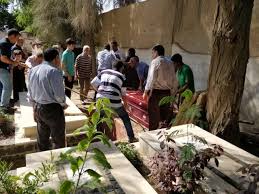
Dr. Ghanea’s findings, which focused on the violation of funeral rights for minorities around the
world, noted that the Baha’i Faith has been banned in Egypt since Gamal Abdel Nasser’s 1960
presidential decree. Baha’is have been unable to acquire cemetery lands since the decree and are
barred from using public plots—leading to a situation in which Baha’is are forced to bury the
remains of loved ones upright in overcrowded graves in a historic Baha’i cemetery.
Dr. Levrat’s report notes that Baha’is in Egypt are barred from giving their religion on official
documents, violating the International Covenant on Civil and Political Rights, to which Egypt is
a signatory. The discrimination Baha’is face “must be firmly condemned and immediately
stopped,” Dr. Levrat added.
“Baha’is in Egypt need solidarity from the international community, civil society, the media, and
justice-seekers everywhere,” Dr. Haddad said. “When UN officials and experts acknowledge at
the same time the plight of Egyptian Baha’is, who continue to be deprived of their fundamental
rights and freedoms, it means the time has come for the Egyptian authorities to stop yielding to
reactionary religious elements and to undo decades of discriminatory anti-Baha’i laws and
policies. Several countries in the region are taking commendable steps to promote coexistence
and inclusive citizenship.”
The authorities have also recently increased arbitrary security interrogations and detentions of
Baha’is.
Dr. Ghanea, in her report, also notes that fatwas by Al-Azhar University, Egypt’s foremost
religious authority, have blocked Baha’is from using public cemeteries and entrenched their
marginalisation in Egyptian society. And in April 2025, eleven UN experts released a letter of
allegations against the Egyptian government detailing the persecution Baha’is face. Egypt denied
the allegations—a denial exposed as false by the community’s experiences.
“All three of these United Nations reports serve as a sharp reminder to the Egyptian authorities,”
Dr. Haddad said, “and we call on the international community to echo the recommendations of
the UN High Commissioner for Human Rights and the UN Special Rapporteurs, to hold Egypt
accountable for its domestic and international human rights obligations.”
“The Egyptian authorities must also cease their latest surveillance tactics and attempts at
coercion—designed to sow fear within the Baha’i community, and among the friends and
neighbours of Baha’is—both of which are blatant civil rights violations,” she added.

Author: Sanjeevni Today
Reporter